


I'm a description. Click to edit me
Comic strips genre:

A visual story told as sequence of drawings or images, either in color or black and white, relating a comic incident, adventure, mystery, or some other manner of narrative. It is often published in serial form as a sequence of panels and gutters, having dialogue printed in balloons and narration in boxes, and uses lot of onomatopoeia.

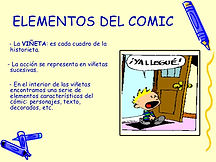
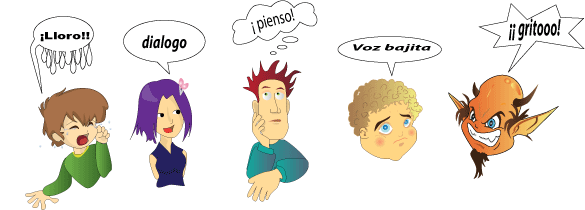
Here there are some specific terms related to comics which are important to understand this genre.
Panel: A geometric shape that contains a scene from a visual narrative. It can occupy the whole or a part of a page. Panels are the organizational framework of comics--the moments of action--and the reader must stitch the sequence of panels together to derive meaning from the work.
Gutter: The gutters are the areas between panels that are sometimes referred to as the breaks or white space that separate the action of a visual narrative. Their importance cannot be underestimated though it is sometimes challenging to conceptualize this. It is in the gutters of a graphic story that the reader makes meaning of the transition from one panel to the next. They can represent the passage of time, a change of place, or no discernible movement at all.
Narrative / Caption Box: These boxes are often located at the corners of panels and provide narration to accompany the dialogue in a graphic story. These boxes are often at their most effective when they are characterized by narrative economy, quickly setting a scene, indicating a transition, or otherwise establishing the time, place, and/or circumstances that a reader must understand before making meaning of an individual panel or panel sequence.
Dialogue Balloon / Bubble: Characters in a graphic novel or comic use dialogue balloons to talk to one another. Often these balloons are oblate (flattened) ellipses that allow typewritten dialogue to fit within them while avoiding an overabundance of white space. Whispers can sometimes be conveyed through dialogue balloons that are formed from dashed lines while dialogue "bubbles" that look like miniature clouds are almost always reserved for things that a character is thinking rather than saying aloud.
Sound Effects: another characteristic of graphic stories that is unique to visual narrative is the use of onomatopoeic sound effects, typically written as highly stylized words across a page in a form that serves as an echo to the sense. Hence, an artist attempting to depict an explosion might use a thick, sans serif font to construct the word "BOOM!" across a panel. These sound effects provide an aural accompaniment to a narrative sequence or individual moment in a graphic story and help the reader more fully understand and process what is happening.
RATIONALE


In the xix Century appeared the first comic images, which occupied a complete newspaper sheet. It seemed that the first one appeared in 1897, at the beginning they were considered recreational reading , but from that time to now it has changed, and it becomes more accepted in society and as well as is accepted as a form of art and literature, and it is has begun to be introduced in classrooms activities. Comics may or may not incorporate text, which with a string of images read one after another to produce meaning.
It has many benefits for students for example a great visual representation of knowledge, it engages the learners through thinking, creating and writing, and it develops creative and higher level thought processes.
It also improves students´ Inference because they need to analyze the strips and with the images and few words draw a logical conclusion and with its design demands critical thinking process too.
La caricatira suele ser un retrato, una representación humoística y satírica que exagera los rasgos físicos o faciales, la vestimenta o bien los aspectos de comportamiento o modales característicos de un individuo, con el fín de producir un efto grotesco. La caricatura además utiliza gran variedad de símbolos y onomaopeyas.
